Thursday, 24 September 2015

Making Orange Candles...


This week room made some ORANGE CANDLES.

We hollowed out the oranges leaving central pith to create a wick.  We used Canola Oil as the fuel to burn the candle.
We were interested if other substances other than wax could be used as a fuel to keep the candle burning.
We noticed that when the candle had been burning for a while the level of oil was reducing.


Remember if you try making an orange candle at home, remember to have an adult to supervise.

Wednesday, 23 September 2015

CANDLE OBSERVATIONS

SCIENCE - I OBSERVE, I THINK, I WONDER...


This week room 3 students have been observing candles and wondering how and why  a candle burns.
We observed carefully the flame, different parts of the flame and recorded our observations, our thinking and also some wonderings.


For a candle to burn, a heat source (commonly a naked flame) is used to light the candle's wick, which melts and vaporizes a small amount of fuel (the wax). Once vaporized, the fuel combines with oxygen in the atmosphere to ignite and form a constant flame.


Thursday, 17 September 2015

DANCING RAISINS Part 2

Dancing Raisins Part 2...

Designing a FAIR TEST

Room 3 decided whether to test density of an object or test the level of carbonation of different sodas.
A fair test needed to be set up.  All measures needed to be the same with only one variable (Change)

If testing the different soda, students needed to have the same amount of raisins, same level of liquid, same type of cup, same temperature.  the only change would be the type of soda.

Some groups were keen to test different types of seeds, different types of dried fruit, different types of soda.

We planned our Fair test, made some predictions, tested the soda or different type of dried fruit, recorded the observations and came to some conclusions..


Questions and consideration for text time around:

How can we measure or record the results better - Do we need a timer or a video?
Does the amount of sugar in the soda effect the amount of carbonation a soda can hold?
Can we carbonate our own water?


Thursday, 10 September 2015

DANCING RAISINS...

Room 3 are continuing to make scientific observations.

I SEE     I THINK     I WONDER

We have been discussing how scientists observe :  using our senses, looking carefully, listening, smelling, tasting and touching.

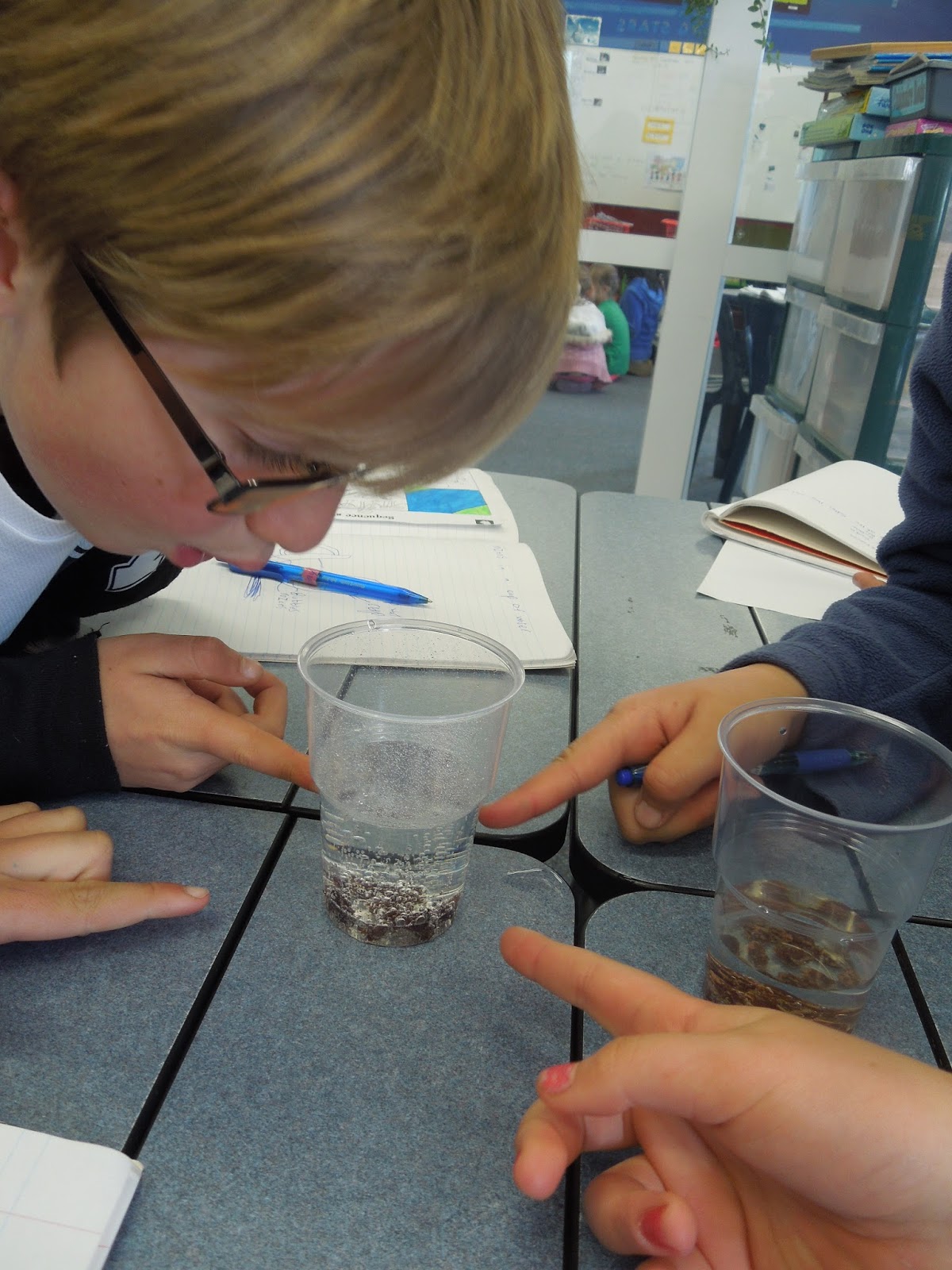
On Tuesday we started with a handful of raisins in a cup of water - we noticed the raisins sunk to the bottom of the cup.  We noticed there were some tiny bubbles of air around the raisins.
We then repeated the experiment but this time with soda water..
Observe ..Observe.. Observe..
The raisins began to rise and sink, and also jiggle around on the bottom ..dancing.  We saw lots of bubbles surrounding the raisins
What was happening and why was it happening?


Discussion:
1. What do you think will happen to the raisins when the water runs out                 of carbonation?  

2.  Why do you think the fizz tastes flat after it has been out for a while?

3.  What is carbonation?  How can you tell it is in the liquid?. 

4.  Define Density:  Density is the amount of mass per unit of volume.

5. Which is denser: raisins or the liquid? How can you tell?  
    The raisins are denser than the soda pop because they sink.


6. What happened to the raisins? Why?


WHERE TO NEXT?
What would happen if we used different objects eg. apple seeds, chick peas, pumpkin seed..
What would happen if we used different carbonated liquids  - is coke more carbonated, what about baking soda and vinegar?
How long would the soda water 'push' raisins up and down?
Does the temperature of the liquid make a difference?


Room 3 Students are now designing a fair science test to test the ideas above ... stay tuned to check out what happens next.

2015 Speech Competition


Congratulations to all of our fabulous students who worked really hard on producing quality speeches and presented them with confidence.

Congratulations to the following Year 5 Finalists:

Paradise Khan - Manakitanga, Caring for Others

Charlotte Schweier - Why We Shouldn't Have HOMEWORK

Te Atarau McGee - Michael Jackson

Neo Higgins-Ohlsen - Why I like coming to school.

We had a range of topics in our class speeches ranging from dinosaurs to hunting adventures, Rugby, Pets. animals, LEGO and Minecraft.

 The year 5 Speech finalists
Neo, TeAtarau, Charlotte and Paradise
Year 5 & 6 Speech Cup Winner - Charlotte


Monday, 24 August 2015

Lake Rerewhakaaitu School Climb our Hill...


A beautiful, crisp winters day blessed us as our school all walked up Rerewhakaaitu Hill.  The impressive mighty Mount Tarawera silhouetted against the blue sky kept a careful watch on us as we all wove through the farm tracks to to the top.  From the top we were lucky enough to see Mount Ruhepehu and Ngaruhoe in the south capped with white snow,  Mount Edgecombe to the north and the mirror like lake or Lake Rerewhakaaitu below us.


Sunday, 23 August 2015

I OBSERVE 

I THINK

 I WONDER

Today Room 3 became scientists using our powers of observation!
Miss Coleman brought in some Huhu Grubs for us to look closely at.  


Our first task was to look very closely, making careful observations at the grubs and record our noticings...

We needed to think about colours, shape, textures, smells, sounds, movements and changes.

Some our findings were: It was bumpy, it looked slimy or wet.  It was moving, it was wriggling.  It expanded and contracted.  It has black substance coming out of it.  It had tiny spikes coming out of the white.  It had rolly rings up and down its body.  It was flexible. It was 4 cm long.  The grub reacts when we touch it by shrinking.

We then recorded what we think...

"I think it is alive because it is moving"  "I think the rings might represent its age"  " I think that the front of the grub is its mouth where the nippers are"  "I think the little spikes make it move faster" " I think it has a tail and a mouth" 
"I think when it extends and shrinks up this is how it moves"

Then we recorded our wonderings...

I wonder if the Huhu grub is related to the Huhu beetle?  Where does the Huhu grub live?  Why are they different colours?  How big do they grow?  How long do they live for?  Why do they have tiny holes?  What do the little spikes do? Can Huhu grub see?  What do they eat?  Is there different kinds of Huhu grubs?  Can Huhu grubs be other colours?


Wednesday, 5 November 2014

WAITOMO OVERNIGHT CAMP & CAVING ADVENTURES


With a touch of nervous anticipation Room 3 gathered at school, meeting to begin our overnight camp and caving adventure.
We headed across the central North Island, our destination WAITOMO….
Day one involved a visit to the Waitomo Discovery centre where we were well informed about the formation of the Waitomo area, cave systems, limestone, stalactites, and stalagmites.  We explored the discovery center examining fossils, skeletons of Moa, Kakapo and many more interesting creatures.  We learned about glow worms, their behaviours and how their beautiful glow is created.
We all embarked on the Ruakuri Bush walk, a beautiful walk through native forest, under rock formations, through tunnels and over a fast moving stream.  We could get a close look at cave weta up in cracks of the caves.
We toured the famous Waitomo Cave and travel down under ground  the glowworm grotto where we traveled through the cave in a boat and were all left speechless as we gazed up and millions and millions of glow worms sparkling down at us.
Our group stayed at TokiKapu Marae.  We experienced a traditional Maori Powhiri and stayed the night sleeping (some us!) in the Whare Nui.
Day two brought us to the Ruakuri Cave.  This was an amazing experience.  We were underground for an hour and a half, travelling down a huge man made concreate drum, around a giant spiral ramp.  Exploring tunnels, left speechless at the amazing stalagmites and stalactites, finding our way in the dark above the rushing stream.  At our lowest point we 65 metres underground!
We traveled to the Otorahanga Kiwi house to learn about the kiwi and we explored the bird and reptile park.
One final adventure found us at the Arapuni dam 65 meters above ground on a swing bridge, over the Waikato River.  We all made it across and back without too many nerves exploding!
A magic time was had by all 20 children and our supportive crew of teachers and parents.  We had a great team and all children were engaged, inspired and challenged throughout.
A special thanks to all the contributions from our families for the home baking, lasagne and apple desserts.  Also to our supportive parents who gave up work and family time to help out on camp.

By Hayley Coleman (Room 3 Teacher)


By Hayley Coleman (Room 3 Teacher)